


The Bajaj Group, one of India’s oldest family businesses and among its largest
conglomerates by market cap at $USD 148 billion, today commemorated 100 years in business – with
Hon’ble Prime Minister Shri Narendra Modi extending his greetings on a milestone that traces India’s
own arc – from the freedom movement to its global economic rise.
Founded in 1926 in Mumbai (then-Bombay) by Jamnalal Bajaj, a freedom fighter, social reformer,
philanthropist, industrialist and considered the fifth adopted son of Mahatma Gandhi, the Bajaj Group
serves one in three Indian households and employs over 130,000 employees.
With over 100 companies, exports to over 100 countries, and an upcoming foray into healthcare, the
Bajaj Group has built one of India’s most trusted brands across automobiles, financial services,
consumer electronics and engineering. Some of its listed companies include Bajaj Auto, Bajaj Finserv,
Bajaj Holdings & Investment, Bajaj Finance, Bajaj Housing Finance, Bajaj Electricals and Mukand.
In a message to the Bajaj family recognising the Bajaj Group’s contributions to nation-building,
Hon’ble Prime Minister Shri Narendra Modi, said, “On the occasion of the centenary of the Bajaj
Group, I extend my greetings and best wishes to everyone associated with this milestone. A hundred years
is a significant journey for any institution. It reflects not only longevity, but also the ability to adapt to
changing times, contribute to economic growth and remain relevant across generations.
“Started under the leadership of Shri Jamnalal Bajaj, the Bajaj Group has been a part of India’s industrial
and economic landscape through many phases of our nation’s development. It has grown into a
diversified company with operations across various sectors, which serve customers both in India and
across the world.
“Over the decades, the Bajaj Group has played an important role in nation-building by creating jobs,
fostering innovation and supporting community development. Milestones such as this are an opportunity
to reflect on key contributions, as well as to renew commitment towards growth, sustainability and
inclusive progress.
“India is moving forward with new aspirations in manufacturing, innovation and global competitiveness.
Institutions with deep roots and experience such as the Bajaj Group have an important role to play in
shaping the journey towards Viksit Bharat by 2047.
Greetings to everyone at the Bajaj Group once again on this memorable occasion. I am confident that the
years ahead will be about continued progress and meaningful contributions to the nation’s development.”
The Bajaj Group’s social impact efforts, focused on youth skilling and employment, child health,
education and protection, have positively impacted the lives of over 10 million beneficiaries.
The centenary celebration at the National Sports Club of India, Mumbai, brought together family
members, captains of industry, Union and State Ministers, political leaders, celebrities and partners.
The evening traced the family’s journey, from its role in India’s freedom struggle, through the shift
from trading to manufacturing and financial services, to new-age technologies that its businesses lead
today.
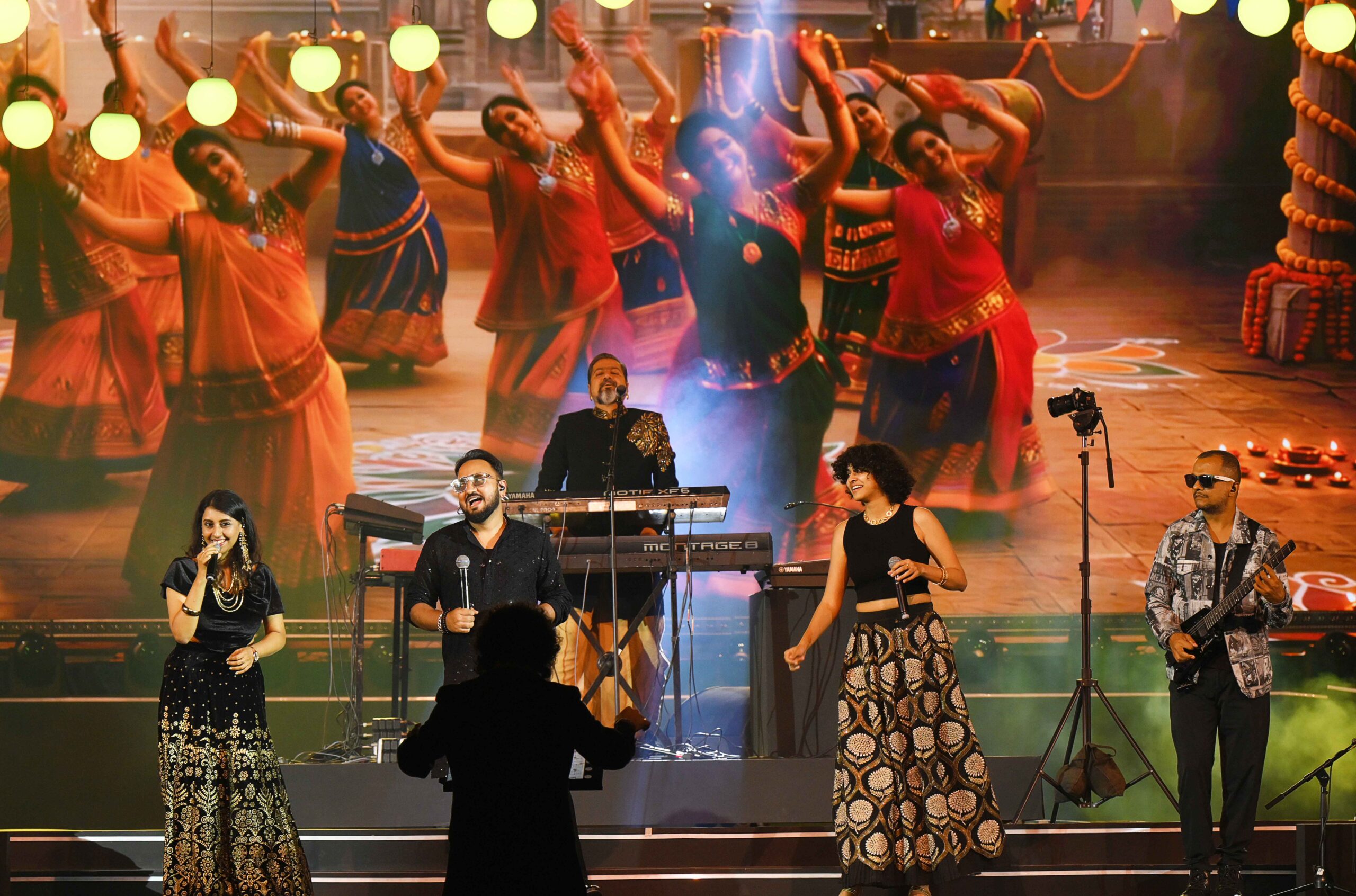
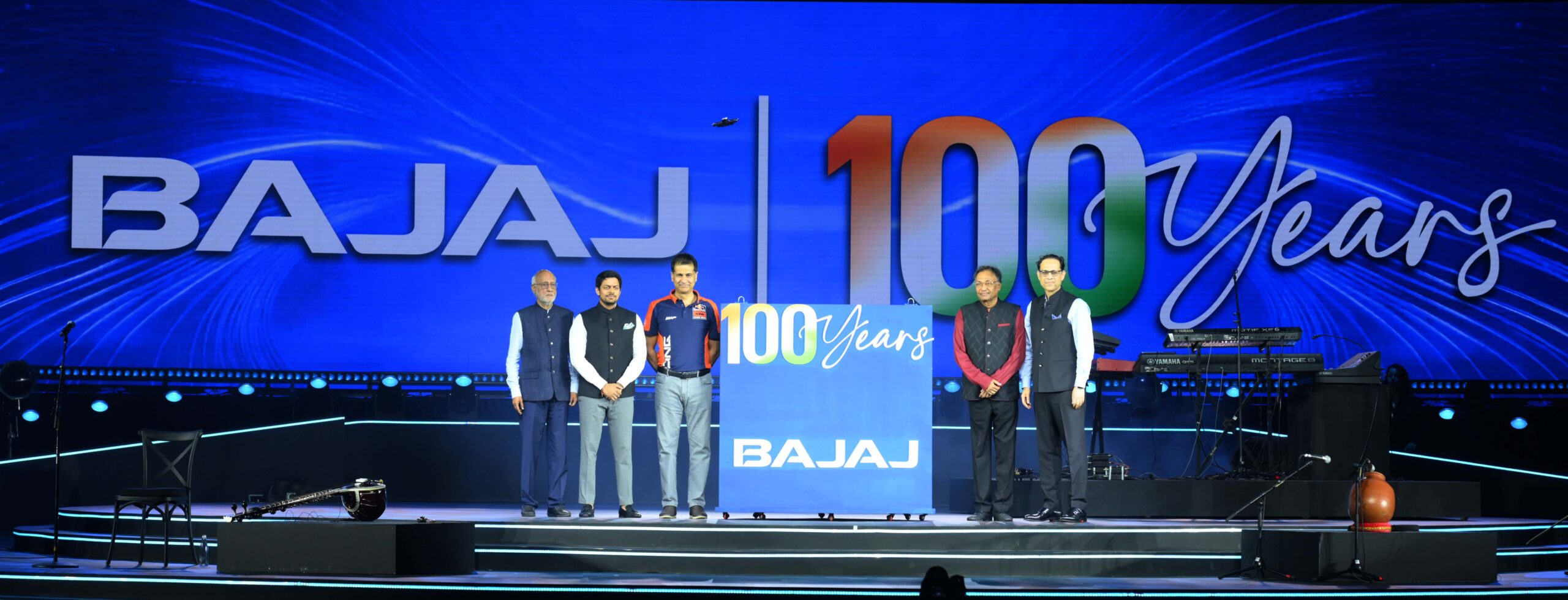
Highlights included addresses by the Bajaj family, a specially composed live performance by Grammy
award winner and globally acclaimed composer Ricky Kej and his troupe, the screening of ‘Kathni
Karni Eksi’, a film on Jamnalal Bajaj and Mahatma Gandhi, directed by Rajkumar Hirani, and the
unveiling of the ‘100 years of Bajaj’ logo.
Speaking on the occasion:
Niraj Bajaj, Chairman, Bajaj Auto, in his address themed ‘India and Bajaj’, said:
“As a family, we thank our Hon’ble Prime Minister Shri Narendra Modi for his wishes and encouraging
words. The story of Bajaj and the story of India have never really been separate. India’s journey towards
self-reliance did not begin recently. It began nearly a century ago — when visionary Indians believed that
Bharat must build for itself, produce for itself, and stand on its own feet. One of those pioneers was
Jamnalalji — our founder. His philosophy of ‘common good over individual gain’ shaped our decisions
across generations. His spouse, Jankideviji Bajaj, was India’s first lady recipient of the Padma Vibhushan.
Jamnalalji’s philosophy was taken forward successfully by his sons Kamalnayan Bajaj and Ramkrishna
Bajaj, both brought up under the eye of Mahatma Gandhi, during their formative years. Thereafter, Rahul
Bajaj, a giant among corporate leaders, established a result oriented yet human, ambitious yet honest,
organization. As industries grew and capabilities expanded, one thought remained constant: Build in
India. Build for India. And build India.”
Rajiv Bajaj, Managing Director, Bajaj Auto, in his address themed ‘Globalisation’ said:
“What we say and what we do must always be the same. And perhaps that is why the Bajaj journey did
not become just a story of growth. It became a story of trust. Today, Bajaj Auto is not just one of India’s
largest two-wheeler companies. It is among the top three globally. Our vehicles are sold in over 100
countriesin Africa, Latin America and Southeast Asia. The Pulsar brand today stands with global players,
not behind them. And when we partnered with KTM, an iconic Austrian motorcycle company —
it was not just a business deal. This shows that an Indian company is not just a follower, it is a co-creator
of global brands. It also proves that legacy and innovation can walk together. Today’s India does not only
participate, but it also competes in the global economy.”
Nirav Bajaj, CEO, Bajaj Integrated Health System, in his address themed ‘Inclusive Development’
said:
“Jamnalalji believed that business was not separate from society. He said business should be pursued with
a view to benefit the poor. Within the family, we often say that society must profit from profit itself. That
has meant ensuring that growth reaches even the poorest of the poor. Bajaj Beyond, our CSR initiative, is
the next expression of a 100-year philosophy. An effort to take everything we have learned and build
models that can scale across India. Across education, livelihoods and sustainability, with a clear ambition
to enable and impact over 2 crore young Indians in the next five years. Because if the first 100 years were
about building institutions, the next 100 will be about building ecosystems.”
Sanjiv Bajaj, Chairman & Managing Director, Bajaj Finserv, in his address themed ‘India and the
Next 100’ said:
“My father Rahul Bajaj would often say – I firmly believe in the ‘Idea of India’, in our country’s diversity
and in its enterprising youth. The next chapter of India’s rise will be written by technology and innovation,
and most importantly by the youth. At Bajaj, we don’t see AI only as a technology trend. We see it as a
powerful force that will further financial inclusion. Because access to finance
actually means access to opportunity. For over a century, we have viewed our businesses through this
same lens: as platforms built to offer hope, freedom, and entrepreneurship. We believe that when
potential is given a stage, the entire country moves forward.”
Shekhar Bajaj, Chairman & Managing Director, Bajaj Electricals, in his address on Jamnalal
Bajaj’s values and the social impact he created, said:
“Jamnalalji’s work spanned social equity, education for women and children, rural upliftment, promotion
of khadi, abolition of purdah, dowry, child marriage and whole-hearted participation in the freedom
movement. Should success be measured only in numbers and scale? Or in lives touched, values upheld,
and communities strengthened. As we step into the next 100 years of Bajaj perhaps the answer to that
question will define the institution we continue to build.”
Timeline of historical events
• 1921: Jamnalal Bajaj participates in the Non-Cooperation Movement. He renounced the title
of Rai Bahadur conferred on him by the British.
• 1923: Jamnalal Bajaj participates in the Nagpur Satyagraha to uphold the honour of the Indian
national flag.
• 1926: The Bajaj Group traces its roots to founder Jamnalal Bajaj who set up the Group’s first
office in Mumbai (then-Bombay)
• 1928: Bajaj family-run temple, Laxmi Nayan Mandir, becomes first temple in India to allow
Dalits to enter, despite objections from orthodox priests and Brahmins. On 17 July 1928,
Acharya Vinoba Bhave led a group of Dalits inside. Mahatma Gandhi visited the temple to seek
blessings before leaving for Mumbai to launch the Quit India Movement. Interestingly, the
idols in this temple are adorned with khadi.
• 1929: Jamnalal Bajaj participates in the campaign to boycott the Simon Commission.
• 1930: Jamnalal Bajaj participates in the Salt Satyagraha with Mahatma Gandhi.
• 1932: Jamnalal Bajaj is arrested by the British and sent to the Dhulia Jail. In Dhulia Jail,
authorities had accorded him an “A” Class, meaning he would be given different barracks from
the rest of his colleagues. Jamnalal Bajaj instead preferred to be imprisoned in the “C” class
barracks.
• 1934: The Hindustan Housing Co. is established.
• 1938: Jamnalal Bajaj is elected the chief of the Jaipur Rajya Praja Mandal. As chief he
negotiated a truce between the Maharajas of Sikar and Jaipur. He played a key role in resolving
the Sikar dispute with the British.
• 1938: Jamnalal Sons Private Limited & Radio Lamp Works is established. Kamalnayan Bajaj
acquires the company in 1954.
• 1939: On Mahatma Gandhi’s suggestion, Jamnalal Bajaj acquires Mukand Iron & Steel Works
in Lahore. Later, in 1989, the name of the company is changed to Mukand.
• 1941: Bajaj International is set up.
• 1942: The first draft of the Quit India Movement (1942) was passed in late 1930s at Bajajwadi
in Wardha. The Bajajwadi had become the epicenter of Gandhiji’s political and social activities.
It came to be known as “National Guest House” during the freedom struggle, since it was
frequently visited by eminent political leaders, freedom fighters, social activists, etc. These
included Jawaharlal Nehru, Dr Rajendra Prasad, Maulana Abul Kalam Azad, Sarojini Naidu,
Subhas Chandra Bose, Sardar Vallabhbhai Patel, Khan Abdul Ghaffar Khan, etc.
• 1942 : The Jamnalal Bajaj Seva Trust was the first charitable trust formed at the initiative of
Kamalnayan Bajaj
• 1945: Bachhraj Trading was founded.
• 1951: The Bajaj’s and ELMI comprising 4 European companies: Philips, General Electric Co,
Crompton Parkinson and Associated Electrical Industries Hind Lamps come together in a 50-
50 partnership to form Hind Lamps.
• 1952: Hind Musafir Agency is created; the company is one of the oldest IATA recognised
agencies in India.
• 1956: Jankidevi Bajaj receives Padma Vibhushan from President of India, Dr. Rajendra Prasad.
• 1960: Bachhraj Trading is renamed as Bajaj Auto and becomes a public company.
• 1960: Bajaj Electricals is created and Radio Lamp Works is merged with it.
• 1962: Hercules Hoist was set up.
• 1963: Bajaj Foundation Trust was set up to offer agro business livelihood opportunities to rural
communities.
• 1965: Rahul Bajaj takes charge of the Bajaj Group. Under his leadership Bajaj becomes a
globally recognised name in two-wheeler manufacturing and finance.
• 1970: Government of India issues a commemorative postal stamp honouring Jamnalal Bajaj.
• 1972: Bajaj Auto launches Chetak under the Bajaj brand
• 1975: Maharashtra Scooters is jointly promoted by Western Maharashtra Development
Corporation Limited and Bajaj Auto Ltd.
• 1977: Jamnalal Bajaj Foundation is established in the memory of Jamnalal Bajaj, with the aim
of promoting Gandhian principles.
• 1980: The Gitai Mandir is inaugurated on October 7, by his kulguru, Acharya Vinoba Bhave.
The temple was conceptualized by Kamalnayan Bajaj to create a memorial for Acharya Vinoba
Bhave’s work ‘Gitai’, a translation of all 700 verses of the Bhagavad Gita into Marathi. The
‘shilanyasa’ (laying the foundation stone) was done by Khan Abdul Ghaffar Khan and the
construction was undertaken by the Kamalnayan Bajaj Charitable Trust. The structure is built
on a sprawling 27.8 acres of land at the site of JamnalalJi’s Samadhi at Gopuri, Wardha.
• 1987: Bajaj Auto Finance was formed to meet the financial needs of the Indian consumers.
• 1998: Bajaj Auto Finance Ltd. is registered with the RBI as a Non-Bank Company, to enhance
access to formal credit to all Indians.
• 1998: Mukand buys stake in Hospet Steel.
• 2000: Bajaj Finserv announces its insurance joint ventures: Bajaj Allianz Life Insurance
Company and Bajaj Allianz General Insurance Company
• 2001: Rahul Bajaj receives the Padma Bhushan from President of India, K.R. Narayanan.
• 2007: Bajaj Finserv was formed as a result of its demerger from Bajaj Auto Limited to focus
purely on financial services.

