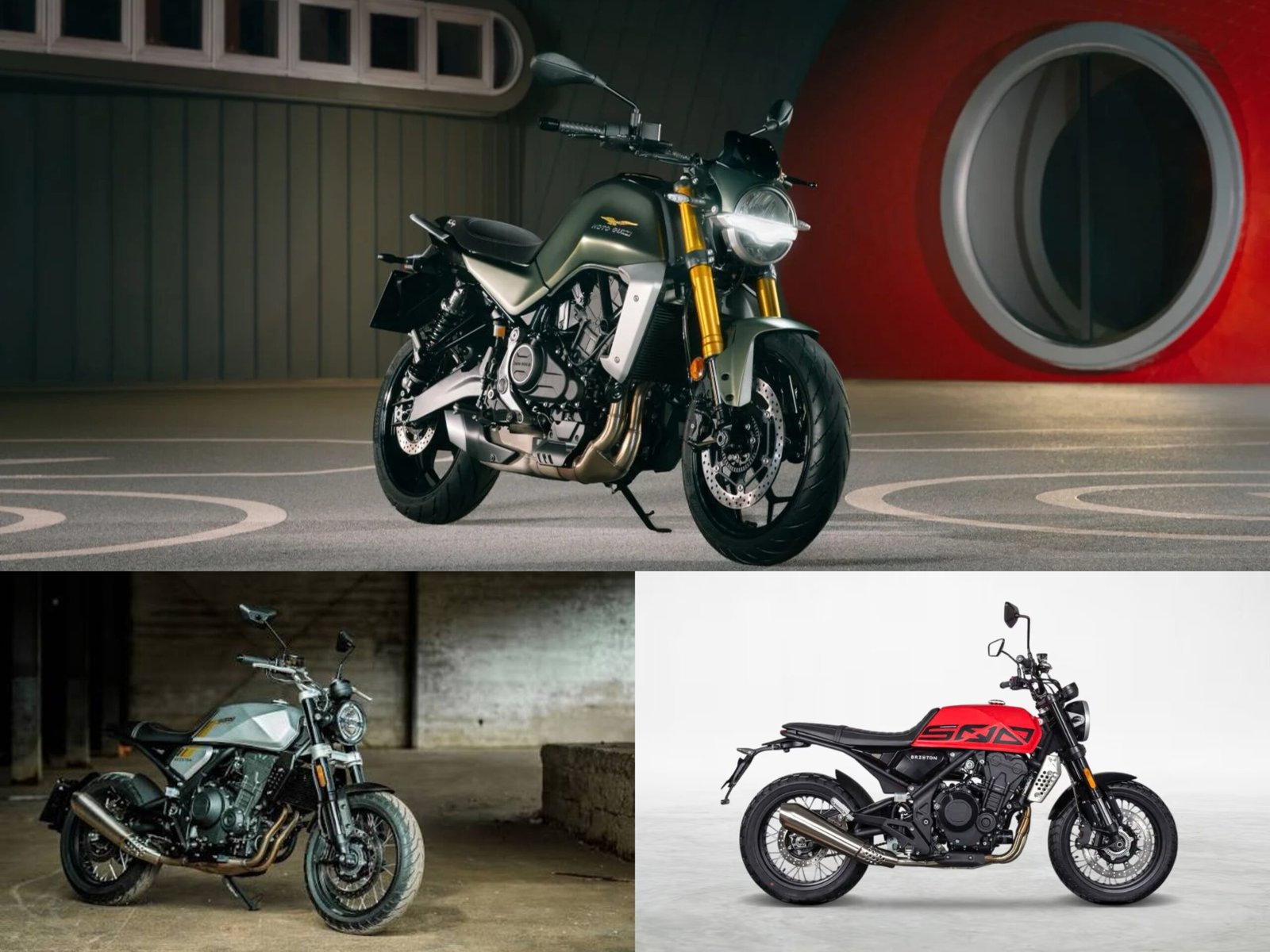
A made in India Moto Guzzi just landed in EICMA and it is something that, as an enthusiast and a Moto Guzzi fanatic myself, would ever think that would happen. Flashback to 2016-2017 when we test drove the bigger Guzzi’s and came back blown away because of the way these motorcycles rode, a similar, smaller packaged bike promises similar characteristics. The 457 platform has been a closely guarded project so we will see how it unfolds. The Bxiton’s on the other hand, launched in 2024, designed in Austria and sold through Motohaus seemed promising enough and hence the comparison of similar looking and packaged motorcycles.
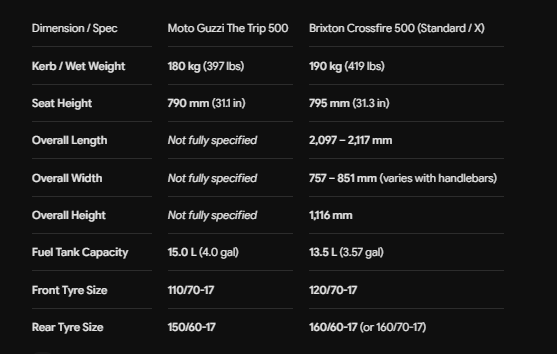
In terms of mass and accessibility, the Moto Guzzi holding a wet weight of 180 kg makes it approximately 10 kg lighter than the Brixton, which weighs around 190 kg in kerb condition. Seat heights between the two models remain remarkably close, with the Moto Guzzi positioned at 790 mm and the Brixton slightly higher at 795 mm. This minimal 5 mm variance ensures that both motorcycles offer an accessible stance suitable for a wide range of rider heights, facilitating easy foot placement when stopped in urban traffic.
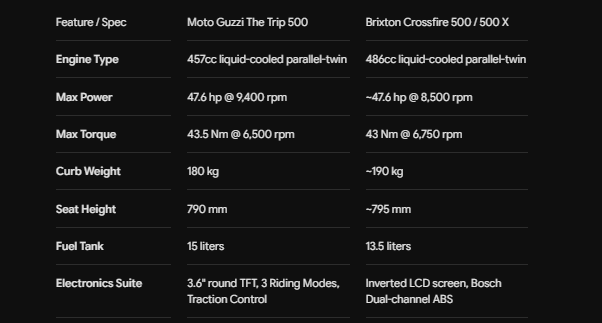
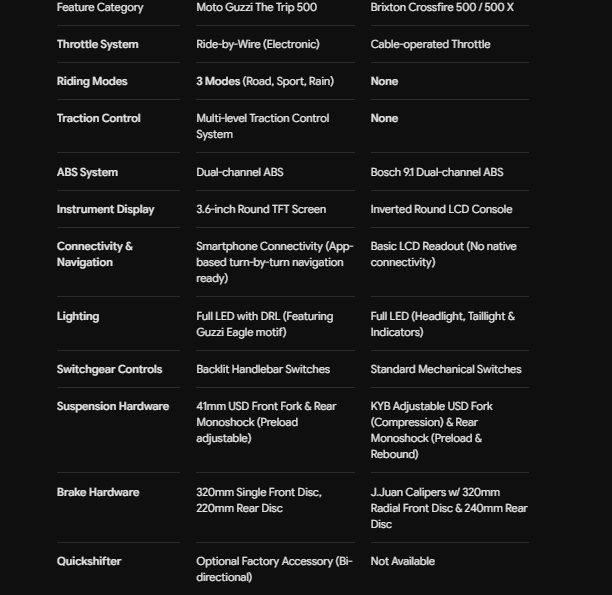
Moto Guzzi The Trip 500: Focuses heavily on modern electronic rider aids. Equipped with Ride-by-Wire, Traction Control, three selectable riding modes, a high-resolution circular TFT display, smartphone connectivity, and backlit switchgear. Brixton Crossfire 500 omits electronic assists like Ride-by-Wire or riding modes in favor of direct mechanical throttle feedback, backed by standard safety electronics (Bosch ABS) and premium hardware components like KYB adjustable suspension and J.Juan radial brakes.
Fuel capacity and wheel configurations further illustrate their functional differences. The Moto Guzzi carries a 15-liter fuel tank compared to the Brixton’s 13.5-liter capacity, offering a slightly larger reserve for longer riding distances. Regarding footprint, the Brixton utilizes a wider set of tires, featuring a 120/70-17 front and a 160/60-17 rear, contributing to a broader stance and a heavier visual anchor on the road. In contrast, the Moto Guzzi relies on narrower rubber—a 110/70-17 front and a 150/60-17 rear—which prioritizes nimble chassis response and quicker directional changes over high-volume tread contact. Overall, while both motorcycles share standard 17-inch wheel diameters and low seat profiles, the Moto Guzzi emphasizes a lighter, more agile package, whereas the Brixton presents a wider, more solid road presence.
The pricing for Brixton Crossfire 500 XC (Scrambler) ₹3,99,999 and the costs Crossfire 500 X (Roadster) ₹4,97,277. The Moto Guzzi should see its closely guarded launch in 2027 with around the same price tag. Both brands, at the same position in the market largely when it comes to premium bikes will fight it off in the market. Stay tuned for the same.