


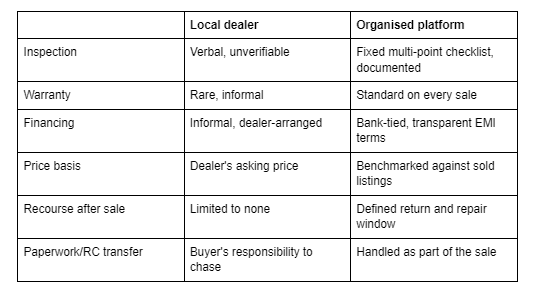
Below ₹5 lakh, most of the used car market still runs on a local dealer’s word. Inspection reports are rare, warranty is almost never offered, financing gets arranged informally, and the price quoted has no benchmark behind it. An organised used car platform, like Cars24 for instance, inspects every listing against a fixed checklist, prices it against real transaction data, plugs it into bank financing, and backs the sale with a written return window and warranty. At this budget, the real risk sits three months out, when something breaks, and there’s no one left to call.
Why the Sub ₹5 Lakh Bracket Behaves Differently
The majority of cars under the ₹5 lakh bracket are usually eight to twelve years old, have run 80,000 to 1,20,000 km, and have already changed hands once or twice. That’s the profile where things can likely go wrong quietly: a masked accident repair, an odometer that’s been rolled back, a battery or clutch that’s near the end of its life. A dealer selling a ₹15 lakh SUV has margin to absorb a comeback complaint and a reputation to protect. A local dealer moving a ₹3 lakh hatchback usually does not, and the buyer at this price point is the one least able to absorb a ₹40,000 repair bill six weeks after handover.
The Pain Points of Buying Under ₹5 Lakh From a Local Dealer -Inspection you can’t verify
Ask a local dealer for an inspection report on a ₹3.5 lakh hatchback and the usual answer is a walk around the car and a short test drive. At this price band, dealers routinely buy stock cheap from auctions or distressed sellers precisely because a flaw wasn’t disclosed to them either. There’s no checklist, no photographed underbody, no record of what was checked. The buyer is relying entirely on how the car feels for ten minutes in a parking lot, for a purchase they’ll be driving daily for the next five years.
No warranty, no safety net
A car in the ₹5 lakh range is old enough that something will need attention within the first year: a suspension bush, a wheel bearing, an AC compressor. Local dealers almost never warranty a sale at this price point. Once the money changes hands, the relationship usually ends there. For a buyer who’s already stretched the budget to afford the car in the first place, an unplanned ₹15,000 repair in month two isn’t a minor inconvenience.
Financing that depends on the dealer’s mood
Banks and NBFCs are less enthusiastic about lending against a ten-year-old car, so financing at this budget often runs through the dealer’s informal network rather than a direct bank tie-up. Terms vary dealer to dealer, documentation is inconsistent, and the buyer frequently doesn’t know the actual interest rate until the first EMI hits. A first-time buyer with a limited credit history, exactly the profile common at this budget, has the least ability to negotiate those terms.
Pricing with no benchmark
There’s no equivalent of a price guide at the local dealer level. The number on the windshield is whatever the dealer thinks the market will bear that week, and it varies wildly between two dealers ten minutes apart selling near-identical cars. A buyer with ₹5 lakh to spend, who’s likely comparing three or four cars across as many dealers, has no reliable way to know if any single quote is fair.
Where an Organised Platform Changes the Calculation
None of this requires the buyer to become an expert overnight. An organised used car platform standardises the parts of the transaction that go wrong most often at this budget: a documented inspection instead of a verbal one, a listed price instead of a haggled one, financing tied to an actual bank rather than an informal arrangement, and RC transfer handled as part of the sale rather than left to the buyer to chase for months afterwards. For someone buying their first car on a tight budget, that removes most of the guesswork from a transaction they have little experience navigating.
What This Looks Like in Practice: Cars24’s Approach Wide, verified choice at every price point
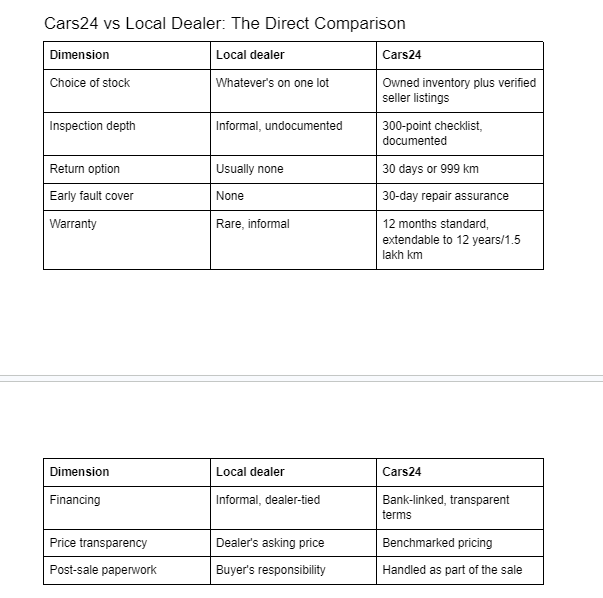
A platform that combines its Cars24-Owned inventory with listings from verified third-party sellers has a materially deeper catalogue at the ₹5 lakh mark than any single dealer lot. That matters more here than at higher budgets, because a buyer with ₹5 lakh has less room to compromise on the one or two features (a working AC, a recent service history) that actually matter to them. More listings also means more chance of finding a car that fits, rather than settling for whatever three cars happen to be sitting on one dealer’s forecourt.
A quality floor that doesn’t move with the price tag
A 300-point inspection covering the engine, electricals, structure, and documentation applies the same way to a ₹3 lakh hatchback as it does to a ₹15 lakh sedan. That’s the part a sub ₹5 lakh buyer benefits from most: the inspection standard isn’t scaled down because the car is cheap. A ten-year-old car that passes a real 300-point check is a fundamentally different purchase than the same car bought off a dealer’s word.
A return window that removes the anxiety of an old car
A 30-day or 999 km return option matters more on an older, higher-mileage car than a newer one, simply because there’s more that could surface once it’s actually driven daily. For a Cars24-Owned Stock inventory buyer who’s put in most of their available savings on this one purchase, knowing the car can be returned within a month if something’s genuinely wrong is the difference between a considered decision and a gamble.
30 days of repair cover from day one
A repair assurance covering the first 30 days catches exactly the kind of early fault that shows up on an eight to twelve-year-old car once it’s in daily use: a sensor, a minor electrical fault, a component that was fine on the test drive and isn’t a week later. At this budget, that 30-day or 1,500 km window, offered with every inventory-owned used car, is often the difference between a manageable inconvenience and an out-of-pocket repair bill the buyer hadn’t planned for.
12 months of extended warranty as standard
A 12-month extended warranty with every inventory-owned used car extends that protection well past the point where most early faults would have shown up anyway. For a buyer whose entire savings went into the down payment, a full year of covered repairs is effectively a year of predictable running costs, which is rare for a car in this age bracket bought anywhere else.
An optional lifetime warranty plan for buyers planning to keep the car long
For buyers who intend to run the car until it genuinely gives out rather than trade up in a year or two, an optional lifetime warranty (available with Cars24-Owned Stock Inventory cars) extending protection up to 12 years or 1,50,000 km from the date of registration reframes the whole purchase. A ₹4 lakh car with that kind of cover attached stops behaving like a depreciating gamble and starts behaving like a known, budgeted cost over its full working life.
Who This Matters Most For
The first-time buyer on a fixed budget: with no prior experience judging a used car, no spare cash for surprise repairs, the inspection report and the return window are what keep a first purchase from turning into a costly lesson.
The family buying a second car: less time to shop around across ten dealers, and less appetite for negotiating financing terms informally. A platform that bundles inspection, pricing, and financing into one transaction fits how much time this buyer actually has to spend on the decision.
The buyer planning to keep the car for the long haul: The lifetime warranty option is built for exactly this buyer: someone treating a ₹4 or ₹5 lakh car as a long-term asset, who benefits most from spreading protection across 12 years rather than one.
Final checks, regardless of where you buy:
Get the inspection findings in writing before you pay anything.
Get the warranty terms and exclusions in writing before you commit.
Check the financing rate against at least one other quote before signing.
Confirm RC transfer is handled and get a timeline for it.
Ask what the return or repair window actually covers before you need it.
The Bottom Line
At every other budget, the case for organised platforms is about convenience. Under ₹5 lakh, it’s about risk. The inspection gap, the missing warranty, the informal financing, and the unverifiable price all hit harder on a car that’s already old and on a buyer who has the least room to absorb a bad surprise.
An organised used car platform like Cars24 with a hybrid inventory, a fixed 300-point check, a real return window, and warranty cover up to 12 years closes most of that gap in one transaction. Under ₹5 lakh, avoiding one major hidden repair can save 10 to 20% of the car’s purchase price. That’s why written inspections, transparent financing, warranty coverage and a defined return policy often matter more than negotiating the last ₹20,000 off the asking price.

