


When Miguel Galluzzi designed the original Ducati Monster in the early 1990s, he operated on a simple philosophy: “All you need is a seat, tank, engine, two wheels, and handlebars.” Over the past quarter-century, the Ducati Monster has defined and redefined the naked sportbike segment. By tracking key milestone models from 2000 to 2026, we observe a dramatic transformation in chassis engineering, thermal efficiency, electronic integration, and power-to-weight ratios.
Core Evolutionary Insight: From air-cooled analog minimalism to liquid-cooled monocoque precision, the Monster lineage reflects Ducati’s balance between raw mechanical emotion and state-of-the-art superbike technology.
1. The Early Millennium: Raw Analog Foundations
At the turn of the century, the 2000 Monster 900ie represented the peak of classic air-cooled Monster architecture. Powered by a 904 cc 2-valve L-twin engine outputting 78 hp and 83 Nm of torque, it relied entirely on mechanical feedback and raw engine character. Wrapped in Ducati’s signature tubular steel trellis frame and weighing ~192 kg, the 900ie offered an unadulterated riding experience.
In 2001, Ducati shocked the motorcycle world with the Monster S4. By fitting the 916 cc liquid-cooled, 4-valve desmodromic engine from their flagship superbike into the trellis frame, Ducati birthed the modern super-naked class. Producing 101 hp at 8,750 rpm and 92 Nm of torque, the S4 raised performance benchmarks while adding necessary cooling hardware, bumping wet weight slightly to ~212 kg.
2. Refinement & Accessibility: The Modern Mid-Weight Era
By 2008, Ducati sought to make the Monster lighter and more accessible without compromising character. The Monster 696 debuted an upgraded air-cooled 2-valve engine generating 80 hp—surpassing the output of the older 900ie while drastically paring weight down to a nimbler 185 kg. The 696 retained the icon’s iconic tubular steel trellis frame, continuing the traditional aesthetic into the late 2000s.
2000 Monster 900ie
Type: Air-cooled 2-valve
Output: 78 hp / 83 Nm
Weight: ~192 kg
Frame: Tubular Steel Trellis
2001 Monster S4
Type: Liquid-cooled 4-valve
Output: 101 hp / 92 Nm
Weight: ~212 kg
Frame: Tubular Steel Trellis
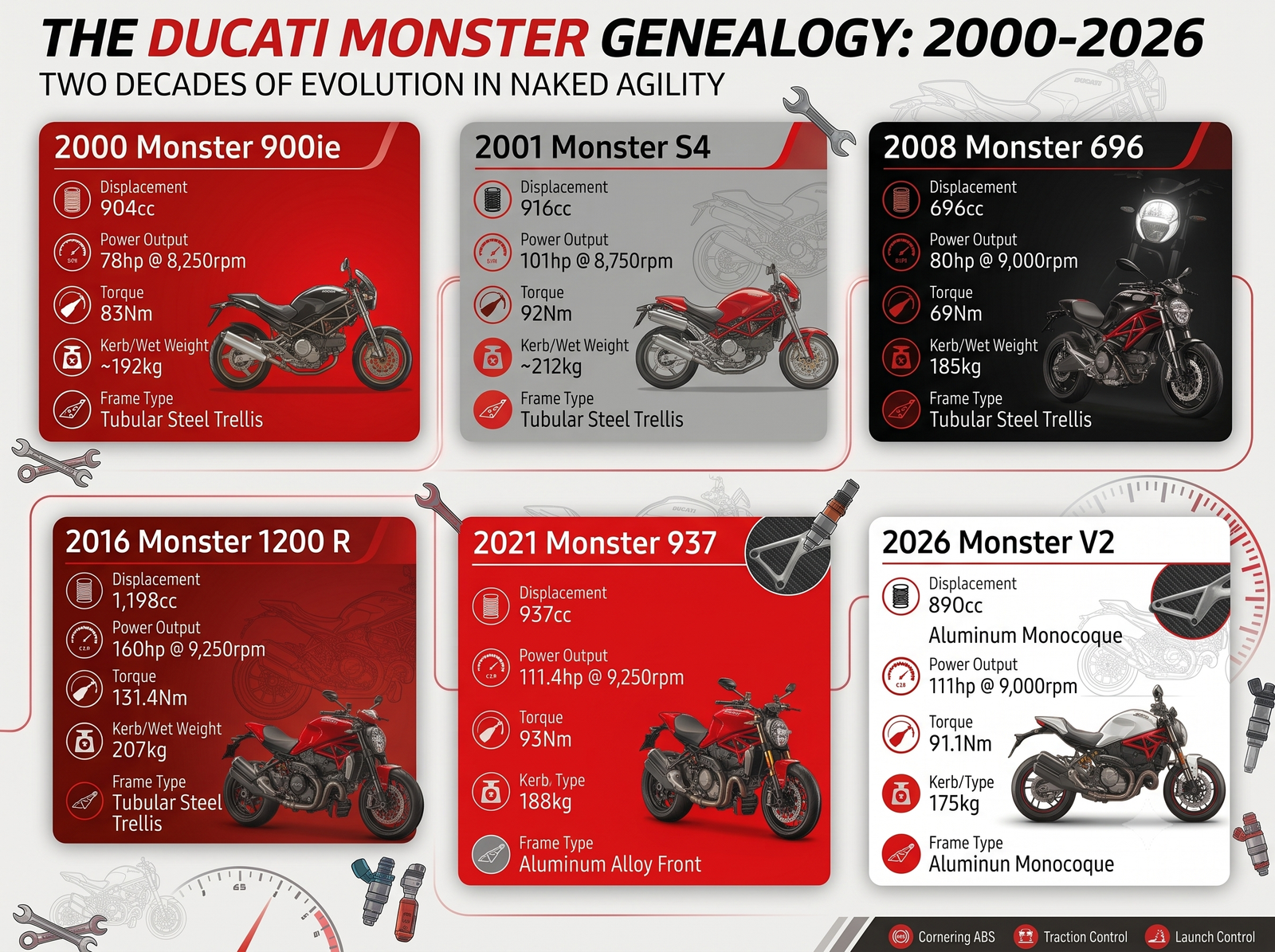
The Ducati Monster Evolution (2000–2026)
3. The Apex of Raw Power: The Superbike Engine Peak
The year 2016 marked the ultimate expression of sheer brute force in the Monster lineup with the Monster 1200 R. Housing a massive 1,198 cc liquid-cooled 4-valve engine, this beast delivered an astonishing 160 hp @ 9,250 rpm and 131.4 Nm of torque. It represented the outer limits of what could be harnessed within a traditional trellis chassis frame, weighing 207 kg.
4. The Architectural Paradigm Shift (2021 – 2026)
In 2021, Ducati made a historic shift with the Monster 937. Breaking from nearly three decades of tradition, Ducati retired the full perimeter steel trellis frame in favor of an ultra-lightweight Aluminum Alloy Front Frame directly derived from Panigale development. With a 937 cc liquid-cooled 4-valve engine outputting 111.4 hp and 93 Nm, the motorcycle shed 19 kg compared to older mid-capacity iterations, coming in at a lightweight 188 kg.
The trajectory culminates in the 2026 Monster V2. Transitioning to a full Aluminum Monocoque chassis, displacement is refined to 890 cc while retaining a punchy 111 hp and 91.1 Nm. Most importantly, kerb weight plummets to a remarkable 175 kg—making it the lightest, most agile full-sized Monster in history.

5. Key Technological Electronics Stack
Modern iterations integrate full rider-aid suites that were unthinkable in the early 2000s analog era:
Cornering ABS Prevents wheel lockup while leaning during emergency braking maneuvers.
Traction Control Manages rear-wheel slip under hard acceleration out of corners.
Launch Control Ensures maximum acceleration from a standstill without front-wheel loft.

The Ducati Monster Evolution (2000–2026)
Summary: The Philosophy Retained Across a quarter-century of technical progression, the Ducati Monster has undergone three major frame transitions:
Tubular Steel Trellis (2000–2016): Iconic visual identity emphasizing mechanical raw exposure.
Aluminum Alloy Front Frame (2021): A weight-saving revolution prioritizing nimble handling over tradition.
Aluminum Monocoque (2026): The ultimate fusion of lightweight chassis rigidity with optimal mass centralization.
While purists initially debated the departure from the iconic steel trellis frame, the performance dividends are undeniable. The 2026 Monster V2 delivers 33 horsepower more than the 2000 Monster 900ie while shaving off 17 kilograms of weight, equipped with comprehensive electronic rider aids. The Monster’s core identity—a stripped-back motorcycle delivering maximum street thrill—remains as potent today as it was in 1993.

: Iconic visual identity emphasizing)