


The Nissan Tekton and the Renault Duster, both are built on the shared CMF-B platform under the Nissan-Renault global alliance. As sister vehicles, they share identical core physical proportions: a 2,657 mm wheelbase, a 1,815 mm width, and a ground clearance of 212 mm. However, they differ in design language, powertrains, interior ambiance, features, overall pricing range, and long-term warranty options. Let’s find out what is on offer.
Dimensions & Space
In terms of exterior dimensions, the Nissan Tekton measures 4,349 mm in length and 1,674 mm in height, making it slightly longer and lower than the Renault Duster, which measures 4,346 mm in length and 1,694 mm in height. Boot space varies depending on the powertrain: the Nissan Tekton offers 518 Litres of boot capacity (expandable to over 700 Litres with seats folded). The Renault Duster provides 517 Litres in its standard petrol configurations, but boot space drops to 372 Litres in the Strong Hybrid variant to accommodate the battery.
Engines & Performance
The primary performance difference lies in powertrain selection. The Nissan Tekton offers two turbo-petrol engines: a 1.0-litre T160 3-cylinder turbo-petrol producing 100 PS and 166 Nm of torque, and a high-performance 1.3-litre T280 4-cylinder turbo-petrol outputting 163 PS and 280 Nm of torque.
The Renault Duster offers a 1.0-litre TCe 100 3-cylinder turbo-petrol (100 PS / 160 Nm) and a 1.3-litre TCe 160 4-cylinder turbo-petrol (160 PS / 270 Nm). Uniquely, the Duster also offers a flagship 1.8-litre E-Tech 160 Strong Hybrid engine combining a 4-cylinder petrol engine with dual electric motors for a combined output of ~158 PS, which is not offered on the Tekton.
Transmission & Fuel Efficiency
Both SUVs come standard with a 6-speed manual transmission on their base engines and a 6-speed Dual-Clutch Transmission (DCT) on their 1.3-litre turbo-petrol variants. The Duster Strong Hybrid is paired with an e-CVT automatic.
For fuel efficiency, the Nissan Tekton delivers an ARAI claim of 19.4 km/l for the 1.0L Turbo MT and 18.5 km/l for the 1.3L Turbo DCT. The Renault Duster delivers 19.2 km/l (1.0L MT) and 18.2 km/l (1.3L DCT). The standout efficiency model is the Renault Duster Strong Hybrid, which boasts an ARAI fuel efficiency of ~29.0 km/l.
Exterior & Styling
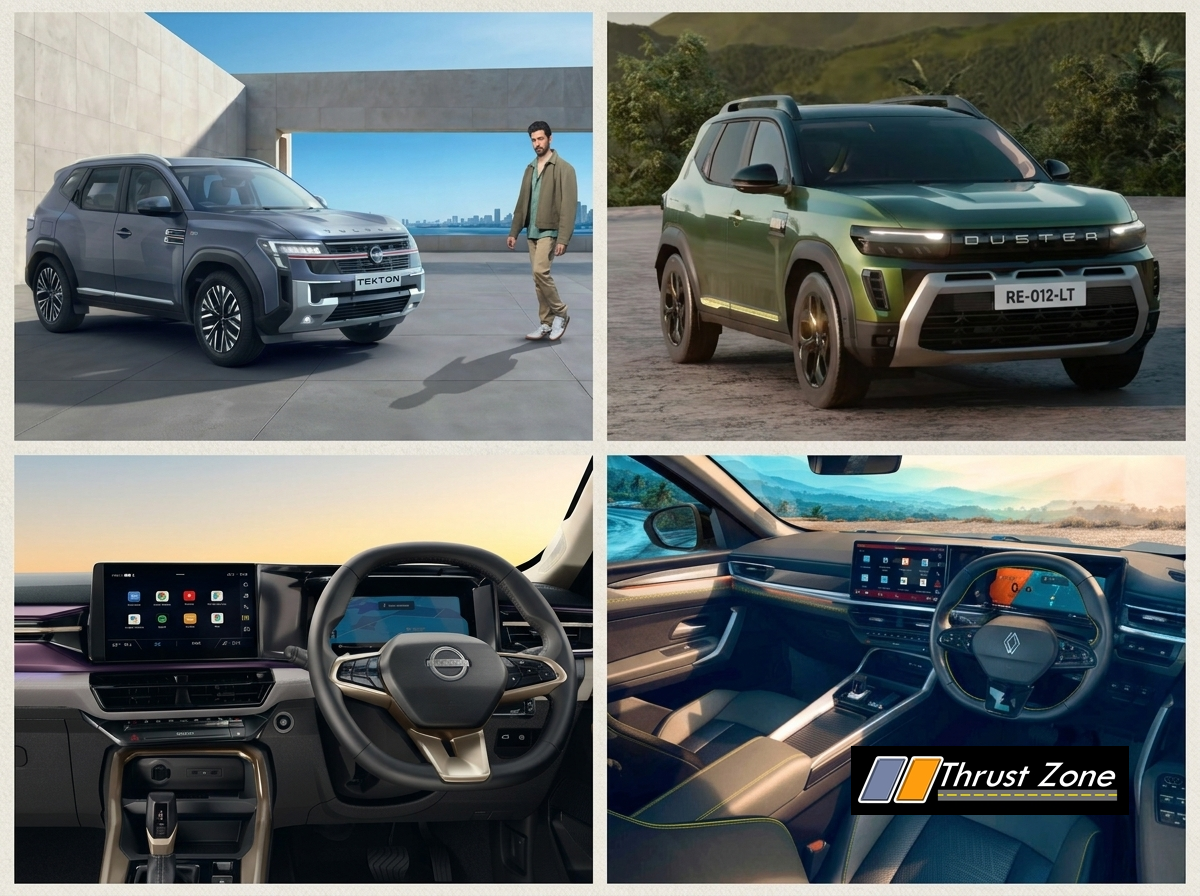
The two SUVs showcase distinct design identities. The Nissan Tekton adopts styling cues inspired by the Nissan Patrol, featuring a large front grille with block lettering, tri-tone design accents, 18-inch diamond-cut alloy wheels, satin silver roof rails, and connected LED tail-lamps.
The Renault Duster maintains its rugged off-road legacy, featuring a prominent Y-shaped DRL lighting signature, a wide front bumper guard, heavy side door cladding, 18-inch “Adventure” black alloy wheels, a horizontal rear light bar, and modular roof bars with a 50 kg load capacity.
Interior & Infotainment Tech
Inside, the Nissan Tekton features a tri-tone soft-touch cabin in Black, Navy, and Tan, equipped with a 10.25-inch touchscreen infotainment system supporting wireless Android Auto and Apple CarPlay, alongside a 10.25-inch HD digital driver display.
The Renault Duster sports a dual-tone Black and Charcoal cabin with yellow stitching details and uses an advanced 10.1-inch OpenR Link infotainment system with native Google Built-in and Google Gemini AI integration, paired with a 10.25-inch digital cluster capable of displaying full navigation maps directly in front of the driver.
Comfort & Safety Features
Both vehicles are well-equipped with modern comfort features, including ventilated front seats, dual-zone automatic climate control, powered front driver seats, and a 360-degree 3D camera system. The Duster includes a panoramic sunroof, Multi-Sense 48-color ambient lighting, and an AQI PM 2.5 air filter.
Safety across both models is anchored by 6 standard airbags, electronic stability program (ESP), hill-start assist, and TPMS. Both feature advanced driver assistance systems: the Nissan Tekton comes with a Level-2 ADAS suite (including Autonomous Emergency Braking, Lane Keep Assist, and Traffic Sign Assist), while the Renault Duster offers a 17-feature ADAS suite with blind-spot monitoring and front/side parking assistance.
Price Range, Trims & Warranty
The Nissan Tekton is priced between ₹10.49 Lakh and ₹18.59 Lakh (ex-showroom) across six trim levels: Visia, Visia+, Acenta, N-Connecta, Tekna, and Tekna+. The Renault Duster is priced between ₹10.49 Lakh and ₹19.49 Lakh (ex-showroom) across its six trims: Authentic, Evolution, Adventure, Techno+, Iconic, and Emotion (the top-end variant price is for the Strong Hybrid powertrain, the Turbo petrol At costs 18.49 lakhs).
Both vehicles come with a standard manufacturer warranty of 3 Years / 1,00,000 km. However, extended warranty coverage differs: Nissan allows coverage expansion up to 5 years, whereas Renault offers extended coverage up to 7 years under the Renault Forever Program. All in all both offer great driving SUV’s in their class at good pricing!

