


Vietnam’s old “screw” joke recedes quietly as VinFast’s steady growth at home and its entry into India offer a modest reminder that industrial confidence can take shape gradually, reshaping assumptions about what countries like Vietnam and India can build for themselves and eventually share with others.
For a long time in Vietnam, a joke circulated in engineering circles that the country could not manufacture even a single export-ready screw. It was the kind of line that lingered longer than the laughter that followed it, a reminder of a time when Vietnam saw itself as the world’s workshop floor rather than one of its innovators. It suggested limits that felt almost cultural, as if industrial capability were something inherited rather than learned. But like most myths built on resignation, it was only waiting for someone to test it.
That test came in the form of a homegrown electric automaker named VinFast. And as its vehicles now enter Indian roads, the old joke has begun to sound not quaint, but outdated.
The Screw Myth Meets 124,264 EVs
The moment VinFast’s production lines in Hai Phong sprang to life eight years ago, Vietnam’s relationship with industrial ambition shifted. This year, it shifted again. By the end of September 2025, VinFast had already delivered 103,884 electric vehicles in Vietnam, a figure no other automaker in the country’s history has approached within such a short span of time. In October, the company broke yet another ceiling, handing over 20,380 vehicles in a single month and lifting total domestic sales for the year to 124,264.
These numbers matter not only because they represent commercial scale, but because they are an answer to a generational question about what Vietnam can build, and for whom. The screw, once a symbol of limitation, has quietly become a symbol of possibility.
That story now continues in India.
A Self-Made Ecosystem Meets a Self-Confident Market
India, like Vietnam, has lived through its own long debates about industrial destiny. Both countries have grown from agrarian pasts into key players in global supply chains. Both have struggled to shake off the narrative that they produce for others rather than for themselves. And both now find themselves at the center of the global electric vehicle transition.
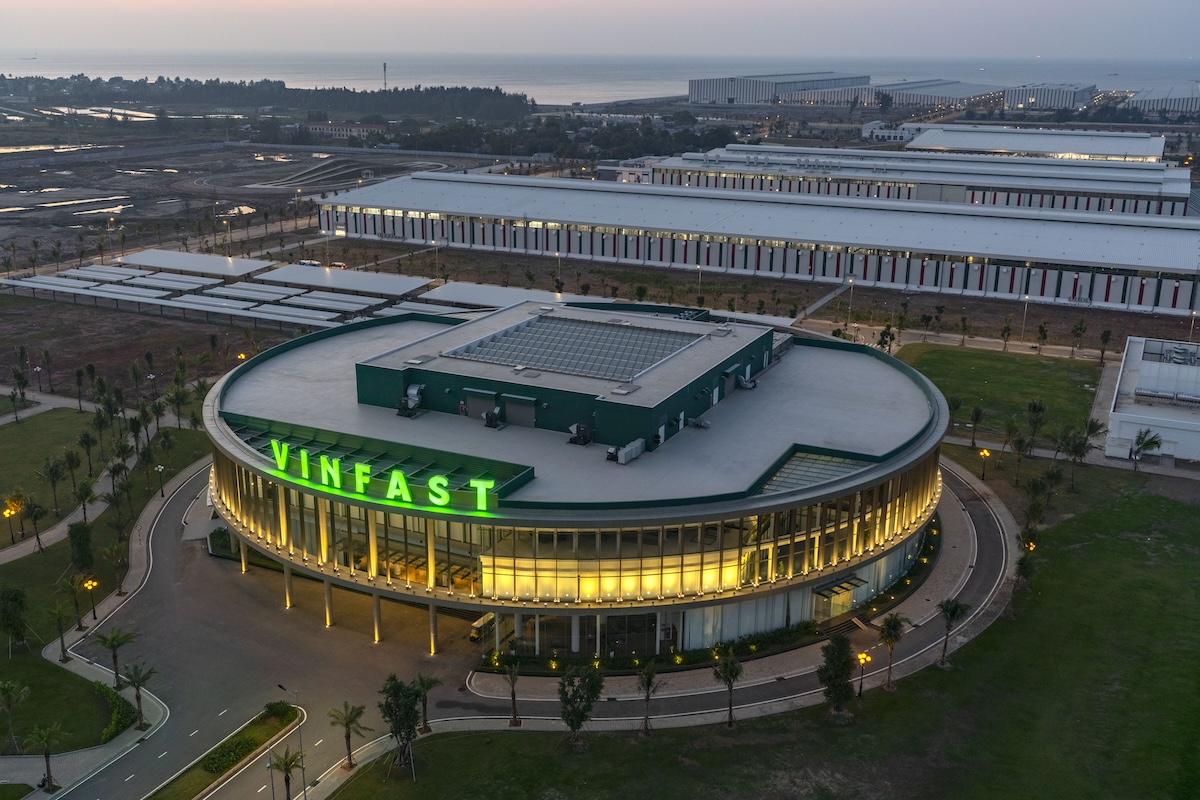
When VinFast entered India, the interest from consumers, policymakers, and industry observers perhaps had less to do with novelty and more to do with familiarity. Here was a company from a fellow Asian nation that had been steadily climbing the industrial ladder over a relatively short period, not by claiming exceptionalism but by working with focus and urgency. Its Hai Phong factory was completed in twenty one months, followed by a second major facility in Ha Tinh. Together, these plants laid the early foundations of a domestic EV ecosystem in Vietnam.
VinFast’s localization process has been equally swift. In the early days, most components came from overseas suppliers. Today, over 60% of a VinFast vehicle’s content is sourced within Vietnam, with the company aiming to reach 84 percent in the coming year. This localization was not achieved through megacorporations but through the upgrading of hundreds of small and mid-sized Vietnamese firms. Industrial parks around Hai Phong and Ha Tinh now supply everything from battery housing to body panels. More than 30% of VinFast’s Hai Phong campus is reserved for supplier facilities.
This localization drive has done more than reduce costs. It has built momentum for a new kind of industrial ecosystem. Hundreds of small and medium-sized enterprises that once supplied electronics or household goods have shifted toward producing components for electric cars, including major components like body panels and electric motors[1].
For Indian manufacturers, many of whom are navigating similar transitions, the Vietnamese model offers an intriguing case study. It shows what can happen when a domestic automaker is willing to build an ecosystem rather than merely assemble within one.
Building Trust and the Home Victory
VinFast’s dominance in Vietnam has owed much to what it call its three core principles: High-quality products, inclusive prices, and exceptional after-sales policies. In practice, this has meant long warranty periods, competitive pricing against imported rivals, and a service model that ensures customers’ satisfaction. Over the course of eleven straight months in 2025, VinFast remained Vietnam’s best selling car brand, outpacing global competitors in the market where those competitors once reigned unchallenged.
This success was never driven by patriotism alone. Vietnam’s national commitment to reach net zero emissions by 2050 created a powerful tailwind that pushed electric mobility from policy vision to public expectation. Entire taxi fleets have transitioned to EVs. Public sentiment has warmed steadily. Charging infrastructure has multiplied across provinces through the joint effort of V-Green and VinFast, with around 150,000 charging points now in operation, all dedicated exclusively to VinFast vehicles. What once felt like an experiment has become an everyday habit, with EV adoption shifting from aspiration to routine practicality.
For Indian readers, these developments may evoke familiar questions. When will EV adoption hit its inflection point. What combination of price, infrastructure, trust, and policy will tip the scale. What role will foreign entrants play in a market where local production and technology partnerships matter as much as competition itself.
The Indian Chapter
It is in this context that VinFast’s India strategy has crystallized into something far more consequential than yet another foreign automaker entering the market.
The anchor is in Tamil Nadu. At a four hundred-acre facility in Thoothukudi, VinFast has begun assembling the VF 6 and VF 7 for India and regional export. Phase one has capacity for fifty thousand vehicles annually and potential expansion to one hundred fifty thousand, creating between three thousand and three thousand five hundred direct jobs as well as several thousand in the surrounding supply chain.
Factories alone do not win markets, but networks do. And VinFast has been hard at work to build one across India from the moment it entered the country. As of late October 2025, twenty four dealerships had opened across the country, from Delhi, Gurugram, and Noida in the north to Mumbai, Pune, Chennai, Bengaluru, Kochi, and Hyderabad, to Ahmedabad, Surat, Bhubaneswar, and Jaipur, with the company on track to reach thirty five outlets by the end of the year.
To support the network, VinFast has stitched together one of the most diverse EV service partnerships now operating in India. Working with RoadGrid, myTVS, Castrol India, and Global Assure, the company has built a backbone for charging, maintenance, emergency support, and parts distribution.
Financing, often the final barrier in India’s EV adoption curve, has been addressed through MOUs with financial parners, the latest being YES BANK. The arrangements often extend both dealer and retail financing, offering customers full on-road funding, flexible repayment options, preferred interest rates, and in-showroom financial assistance.
These moves have not gone unnoticed by the Indian automotive community. At the Jagran Hi-Tech Awards 2025, VinFast was named EV Manufacturer of the Year while the VF 7 was awarded EV Disruptor of the Year. To win one award as a newcomer is notable. To win two is a signal.
Indian analysts have described VinFast’s approach as refreshingly unselfconscious. The company does not resemble a traditional global automaker entering India with predetermined playbooks. It resembles a fellow Asian economy betting boldly on a future that India itself is accelerating toward.
A Regional Story for a Global South Moment
The path VinFast is carving in India mirrors the ideological shift taking root across Asia. Many countries are now questioning old hierarchies in global manufacturing. If South Korea went from postwar scarcity to global industrial leadership, and if China went from a low-cost workshop to the world’s largest EV exporter, then why not others. Why not Vietnam. Why not India. Why not nations that have long been positioned as consumers of technology rather than producers of it.
VinFast’s expansion across Europe, North America, the Middle East, and Southeast Asia reflects a deeper cultural change underway in Vietnam, one that Vingroup, its parent company, has articulated openly for years, a desire to see Vietnam recognized for its intellect and capability rather than its past limitations. It is a vision that has driven everything from the company’s investments in artificial intelligence research to Vingroup’s newly announced Culture pillar aimed at elevating Vietnamese arts on the world stage.
Turning the Last Thread
The old joke about the screw lingers only as historical memory now. Engineers in Vietnam who once laughed at their own limitations now work on battery packs, electric drivetrains, and global vehicle platforms. Technicians trained in Hai Phong are stationed in India, adapting software and hardware to local needs. The vehicles they built travel on Indian roads today, and through them Vietnam enters the daily life of a country that understands the weight of aspiration as well as it does.
Vietnam’s industrial story is still being written, and India’s is far from finished. VinFast is only one chapter, but it is a chapter that illustrates something critical about the twenty first century. Myths do not disappear because someone disproves them. They disappear because someone surpasses the moment that made them believable. Screws once seen as impossible to make now hold together machines that cross state highways in India. In their quiet rotations, they testify to what happens when a country decides to bet on its own capability.
In that sense, the story of VinFast in India is not just about an automaker entering a competitive market. It is about two nations, each transforming in its own distinct tempo, finding common ground in the belief that industrial destiny is not inherited but earned.

