


Buying Your First Heavy Trailer in Australia: Dog, Pig, Tag or Drop Deck
For most owner drivers, the trailer is the second biggest cheque they will ever write after the truck itself. It is also the one that gets the least research. People spend months comparing engines and cabs, then buy whatever trailer is sitting in the yard because the deal looks right.
That shortcut can cost you for the whole life of the rig. A trailer that is too heavy, has the wrong axle group or does not suit the truck’s coupling eats into every load you carry. Over a working life measured in years, a few tonnes of lost payload per trip adds up to real money.
This guide covers the main heavy trailer types, how to match one to your truck and your work, how to sort finance around the combination, and what to check in the first month after delivery.
The main heavy trailer types and what each one is for
Tag trailers
A tag trailer sits behind a rigid truck on a short drawbar, with the axle group close to the truck. Because the drawbar is short and there is no turntable, a tag tends to track well and reverse more predictably than a dog. That makes it popular for plant hire, smaller machinery and work in tight sites. Under the National Heavy Vehicle Regulator’s general mass rules, a rigid truck and tag trailer combination can have a tow mass ratio of up to 1:1.3, so the trailer may be heavier than the truck, subject to the conditions the NHVR sets out.
Pig trailers
A pig trailer also runs behind a rigid truck, with its axles grouped near the centre of the deck and a long rigid drawbar. Pigs are common for general freight, livestock feed, hay and smaller tipper work. The NHVR’s general mass limits treat pig trailer axle groups more conservatively than other trailers: 15 tonnes for a tandem group on dual tyres and 18 tonnes for a tri-axle group, compared with 17 tonnes and 21 tonnes on other vehicles. The NHVR also says that in a combination, the mass of a dog or pig trailer must not be more than the mass of the towing vehicle.
Dog trailers
A dog trailer has a turntable at the front, so the front axle group steers off the drawbar, with a second axle group at the rear. This is the workhorse of bulk tipper work: quarry products, soil, sand and road base. A truck and dog combination spreads the load over more axles than a pig, which is why it suits bulk haulage where every tonne is paid. The trade-off is reversing. A dog has two pivot points, and backing one into a tight tip site takes practice.
Flat top and drop deck trailers
Flat tops and drop decks carry machinery, building materials and anything that does not tip. A drop deck lowers the rear section of the deck, which reduces the overall height of a tall load and makes loading an excavator or skid steer by ramp much easier. For earthmoving operators who move their own gear between jobs, a drop deck behind a rigid or prime mover often replaces the cost of hiring a float.
Australian builders such as Beavertail Trailers make tag, pig, dog and drop deck trailers to order, so the axle group and deck length suit the truck.
As a worked example, take an earthmoving operator running a tandem drive rigid tipper who also needs to move a small excavator. One option is a tag trailer with a drop deck and ramps: it tracks closely behind the truck on narrow access roads and can carry the machine to one job and gravel to the next. A dog trailer would carry more bulk material, but it is harder to load a machine onto and harder to place on a cramped residential block. The right answer depends on which job pays the bills most weeks.
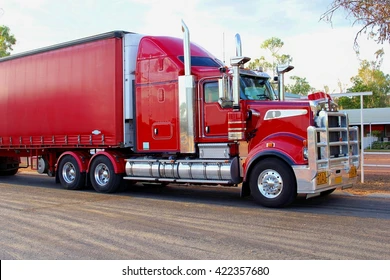
Wideners for oversize loads
Widening trailers extend sideways to carry loads wider than a standard deck. The NHVR’s general width limit for a heavy vehicle is 2.5 metres, and the newer 2.55 metre limit for Safer Freight Vehicles applies only to trucks and prime movers, not trailers. Anything wider moves under an oversize notice or permit, with its own conditions on routes, times, pilots and signage. If oversize work is a sideline rather than your core business, hiring a widener when you need one is often cheaper than owning it.
Matching the trailer to the truck
A trailer is only as useful as the truck that pulls it. Before you sign anything, line up these numbers and specifications.
ATM and carrying capacity
Aggregate Trailer Mass (ATM) is the manufacturer’s rating for the fully loaded trailer. The NHVR is clear that the loaded mass must not exceed the manufacturer’s ratings, including ATM for trailers, GVM for rigid trucks and GCM for combinations, and that no component rating can be exceeded either. That covers the tow coupling, tyres, wheels and axles. Your real payload is the ATM minus the trailer’s tare weight. Two trailers with the same axle group can carry quite different loads because one is built heavier. Ask the builder for the tare on the compliance plate, not a brochure estimate.
Axle groups and mass limits
Legal axle loads come from the NHVR’s General Mass Limits, which were updated on 1 August 2026. Under the current tables, a tandem axle group on dual tyres is allowed 17 tonnes and a tri-axle group on dual tyres is allowed 21 tonnes, except on a pig trailer where the limits are 15 and 18 tonnes. A single steer axle on most trucks is limited to 6 tonnes, rising to 6.5 tonnes for a complying steer axle vehicle that meets the NHVR’s conditions.
The combination is also capped as a whole. The NHVR lists 43.5 tonnes for a vehicle or combination that is neither a B-double nor a road train and does not fall into one of its other listed categories. Your trailer choice has to fit inside whichever limit is lowest: the manufacturer’s rating, the axle group limit or the combination limit.
Tyres
Tyre choice changes the legal limits as well as the running costs. The NHVR tables set different mass limits for single tyres by section width, with wide singles of at least 375 millimetres treated differently from narrow ones. Wide singles save weight and can lift payload, but they suit some roads and loads better than others. Talk to your builder and tyre supplier about the work you actually do before choosing.
Brakes: ABS or EBS
Australian Design Rule 38/05 sets the brake requirements for trailers, and trailers over 4.5 tonnes ATM must meet its full heavy trailer provisions. Most new heavy trailers come with ABS, and many now offer EBS with roll stability functions.
There is a practical reason to care. Since 1 August 2026, the NHVR’s length rules allow many combinations, including truck and dog and truck and tag, to run at 20 metres instead of 19, but only when the heavy trailer has an ADR 38/05 (or later) braking system powered by the towing vehicle. An extra metre can mean a longer deck or more cubic capacity. Check that your truck can power the trailer’s brake system, because the NHVR’s guidance on advanced braking says that if the ABS or EBS plug can be connected, it must be connected.
Coupling type
Rigid truck and trailer combinations normally use a pin-type tow coupling on the truck’s rear, and the coupling rating must cover the trailer you plan to tow. Prime movers use a fifth wheel and kingpin. If you are buying a trailer for an existing truck, get the truck’s coupling rating and the rear overhang measured before ordering, so the drawbar length can be set to suit.
Financing the rig
Many operators finance the truck and trailer together as one package, which looks simple but can tie the two assets together for the whole term. Treating them separately often gives more flexibility. You can replace or upgrade the truck on its own cycle while keeping a trailer that still has years of life, or the other way round.
Truck finance specialists such as Fleet Plan can put the rigid or prime mover on a business lease and treat the trailer as a separate asset.
When you compare finance options, look at more than the monthly repayment. Check the term against the asset’s working life, the balloon or residual value at the end, whether early payout is allowed and at what cost, and who carries the risk if the truck is written off. The tax treatment of leases and chattel mortgages differs, so run the structure past your accountant before you sign. Get quotes on the truck and the trailer as separate lines even if you end up financing them together, so you know what each asset is really costing you.
Protect the site ute, because it takes the most abuse
The heavy gear gets the attention, but the site ute is the vehicle that suffers most. It gets driven onto muddy sites, filled with wet gear, used as a lunch room and shared between workers. Seats wear quickly, and a torn or stained interior hurts resale value when the ute is traded in.Fitted covers from Seat Covers Online keep the site ute’s seats alive through mud, diesel and dogs, and come off for a wash.
While you are at it, add rubber floor mats, a cargo liner and a tidy storage system for tie-downs and chains. Small spending here protects an asset that is easy to forget until trade-in time.
Delivery, registration and your first-month checklist
Delivery and handover
Inspect the trailer at the builder’s yard before it leaves. Check the compliance plate against what you ordered: ATM, tare, axle group and tyre sizes. Walk through the brake system, lights, coupling, landing legs or jockey and any hydraulics. Ask for the build sheet, wiring diagram and the brake and axle manufacturers’ service schedules.
Registration
The NHVR does not register vehicles. New heavy vehicle registrations, renewals and transfers are handled by your state or territory transport authority, and national heavy vehicle plates are issued in every state and territory except Western Australia. The National Transport Commission publishes the national registration charges. For 2026 to 2027, it lists load-carrying trailer charges per axle, for example 801 dollars per axle for a dog or pig trailer with a tri-axle group. Once the trailer is registered, you can confirm the details with the free NHVR Registration Checker app.
First-month checklist
Re-torque the wheel nuts after the first few loaded runs, following the builder’s or wheel manufacturer’s guidance.
Check brake adjustment and look for air leaks once the brakes have bedded in.
Weigh the combination on a weighbridge with a typical load and record the axle group masses.
Confirm the ABS or EBS plug is connected and the warning lamp clears at start-up.
Check suspension bushes, U-bolts and hanger brackets for movement.
Check the drawbar, turntable or coupling for wear and correct lubrication.
Load the trailer’s service schedule into your maintenance system so nothing is missed.
Update your insurance to include the new trailer before the first job.
Conclusion
Buying your first heavy trailer in Australia comes down to three questions: what work pays most weeks, what your truck can legally and mechanically pull, and how you will pay for the combination over its life. A tag or drop deck suits mixed machinery and material work, a dog suits bulk tipper haulage, and a pig suits general freight behind a rigid. Check the ATM, tare and axle groups against the NHVR limits, make sure the brakes and coupling suit the truck, keep the trailer finance flexible, and run through the first-month checklist. Get those right and the trailer will earn its keep for years.

